About Astrolearn Astrology Library
– Last updated: June 4th, 2026
Contents:
- What is Astrolearn?
- Archive of Astrological Literature
- Bibliography of Astrological Literature
- Facsimiles of out-of-copyright Astrological Texts
- Appeal for Funding: Sponsors Sought
- About Philip M. Graves
- Lectures on the History of Astrology by Philip M. Graves
- Publications by Philip M. Graves
- Astrology Books and Journals Wanted
- Privacy Policy
What is Astrolearn?
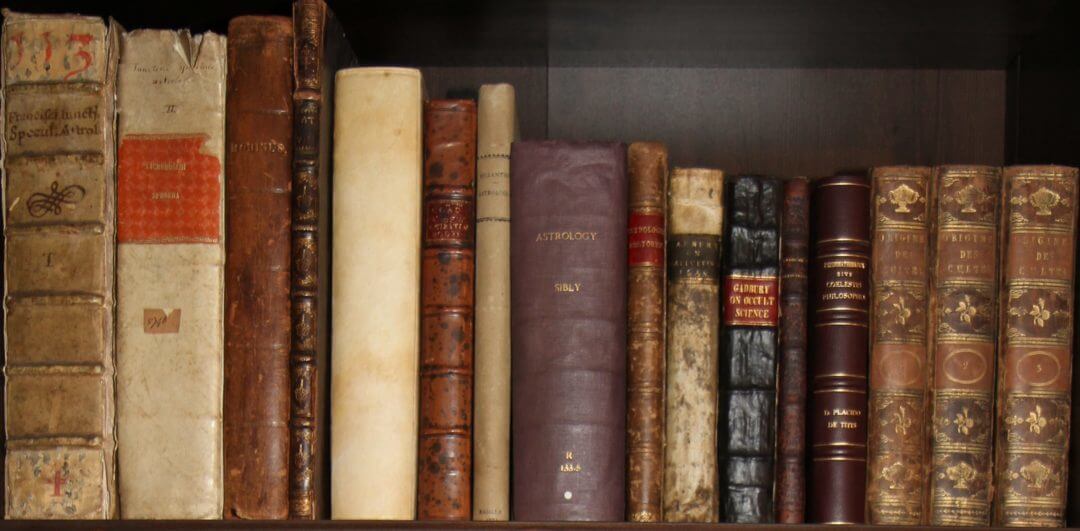
Astrolearn is an astrological learning and reference resource created and managed by Philip M. Graves, a British astrological historian who has also lived for a year in France and over ten years in Sweden. The resource is centered around an archive of printed astrological literature.
The Astrolearn web site was launched in December 2014, a decade after its original outline conceptualisation.
Currently still in the early stages of design and development, Astrolearn will be frequently added to over the coming years, the aim being to develop it into one of the most useful astrological information sources and reference resources on the Internet.
Archive of Astrological Literature
One of the major projects ongoing at Astrolearn is the establishment of a thorough online bibliography of printed astrological literature based upon direct access to and examination of the holdings of the archive of astrological literature maintained and developed by Graves.
The library now numbers approximately 11,000[1] discrete volumes of books and pamphlets on astrology and closely related topics, in addition to over 15,000 individual issues of hundreds of periodicals. This tally ranks it among the most extensively stocked with printed astrological literature of all recorded libraries in Europe today[2], though it is only modest in its overall size compared with typical publicly funded and institutional libraries that hold books on a much wider range of subjects.
The books section encompasses modern critical editions, facsimiles and translations of ancient and medieval texts; over fifty original printings of major works in both Latin and English from the 16th, 17th and 18th centuries; a very extensive range of original 19th, 20th and early 21st century texts in English, French and German; and numerous modern historical studies and dissertations by the foremost scholars in the field.
The periodicals section holds examples and in many cases substantial or even complete runs of hundreds of vintage 20th century magazine, journal and almanac titles in English, French and German, and some even earlier ones in English.[3]
Graves has had a natural affinity with learning foreign languages for as long as he can remember, and lends that to his keen interest in bringing together the extensive French-language and German astrological literature with the English-language equivalent under one roof. The result is a uniquely broad-based historical and contemporary research resource.
The archive is no longer under rapid development owing to limited means and space, but continues to be incrementally added to with important new publications and occasional second-hand ones.
Bibliography of Astrology Books and Journals
The catalogue corresponding to our astrology library had been annotated with over 4000 bibliographical footnotes, and almost completely uploaded to Astrolearn in hundreds of portions indexed from the Bibliography page, by the end of 2015.
It details not only publications’ key attributes (author / editor, title, publisher name and address, year), but also, in the cases of all books published before 1960 and most hardbacks, academic books and historical works published since then, binding format details and full pagination information.
It is our hope further to develop the bibliography in the future with an evaluative role facilitating the critically informed selection by astrologers and students of the history of astrology of important primary and secondary source materials in different areas of the subject. As of May 2025, work is underway on a series of select bibliographies dedicated to particular areas of the subject, which can be found indexed under the Book Lists section of the Articles page. Many more of these are expected to follow.
A special collection of books and journals donated by Dr. Geoffrey Dean was gratefully received in Sweden in the Spring of 2016 and subsequently shelved in the Autumn of 2018 following the relocation of the library to the United Kingdom. Its periodical holdings and directly astrologically relevant book holdings that do not duplicate titles already held have since been fully integrated into our library catalogue, although some books of tangential relevance have been shelved separately and remain to be catalogued.
In the Spring of 2018, a number of wholesale lots originating in the library of the late German astrologer Heinz Specht was auctioned, and we purchased many of these. They included a mixture of astrological and non-astrological contents. The non-astrological ones have been set aside to prioritise the astrological ones in our limited bookcase space. As of late 2024, cataloguing work on these is largely complete.
We would welcome donations of all relevant materials not currently held. Please contact us if you would like your book included in the archive and bibliography. Donations of funds for acquisitions are also gratefully received and used with guaranteed 100% efficiency to purchase additional relevant books and magazines for the archive. You can use the Paypal donations button on the bibliography page or the one on the donations page to this effect, or contact us to arrange a bank transfer. All donations will be acknowledged with a personal message of thanks.
Facsimiles of out-of-copyright Astrological Texts
Over 300 out-of-copyright volumes in the collection have already been converted into electronic facsimiles via high-resolution full-colour scans. These facsimiles, which were originally issued on archival-quality DVD-ROM media, are now available as paid individual file downloads through our dedicated Downloads store.
Appeal for Funding
Sponsors and Benefactors Sought
The Astrolearn website and the underlying library it represents are now supported to a limited extent by second-hand astrological book sales through our bookshop that was first launched in May 2024, as well as through the pre-existing downloads store, and by private astrological research and scanning commissions that are offered from time to time, alongside a small amount of teaching work on the history of astrology.
The library is not in receipt of any external or institutional funding, and presently remains under Graves’s private ownership.
However, it is hoped in the long run to bring it under the shelter of a stable academic institution or trust to protect it from long-term dissolution and to increase its accessibility to researchers, as well allowing for its ultimate relocation to more spacious facilities allowing for future growth in its holdings.
While it remains unfunded, the library cannot operate as an open-access resource or even as a dedicated research facility. It can only be opened to occasional research visitors on application. We hereby appeal to the astrological and broader academic communities to make contact with us to sponsor our library, and ultimately to propose suitable future permanent housing arrangements for the facility that would make it more widely and sustainably useful to scholars and researchers in the future.
Institutions and benefactors with connections to the UK are especially eagerly sought in view of our current location here, although international funding would be welcome, and the long-term international relocation of the library is not necessarily off the table if a satisfactory offer were to be made from a suitably dedicated and well-funded institution that would commit to keeping the library’s resources together.
About Philip M. Graves
Graves is a B. A. (Hons.) graduate in French (University of Hull), who has also studied Swedish to an advanced level, and basic German, Spanish and Latin. He is a CELTA-qualified teacher of English as a Foreign Language to Adults (ITTC, Bournemouth).
A great-nephew of the poet and author Robert Graves, and son of the biographer Richard Perceval Graves, Philip has always been greatly interested in literature, and has written stories, books and songs since an early age.
As a teenager, Graves developed a strong interest in philosophy, enjoying vigorous debates with a philosophy teacher at his Sixth Form College on the words and reasoning of René Descartes and A. J. Ayer. Although he went on to major in French at university, the B. A. programme at Hull was flexible enough to allow him to read philosophy as a minor in the final year, and he took the opportunity to study modules on moral and political philosophy, aesthetic relativism, and abstract ideas. He was equally enthused by the implicit philosophical dimension of the great French novels and plays on his degree course, feeling a strong intellectual connection to many of their authors.
It was in the summer following the completion of his second year at university that Graves began his serious study of astrology from a small selection of books, taking them out with him to France for his year abroad and filling many spare hours with learning and practice. The subject, having previously awakened in him a relatively casual level of interest, now became a consuming fascination, prompting him to seek out many further books as soon as he returned to Britain the following June. A second summer of intensive study ensued.
By the Autumn following, Graves had written an original paper on the theory of harmonic aspects and submitted it under a pseudonym to the Astrological Association of Great Britain for consideration. Although it was not ultimately accepted for publication (the pseudonym was probably a bad idea for gaining the confidence of the board), he was undeterred. By the time of his graduation from his B. A. one summer later, he had acquired and thoroughly absorbed the contents of at least fifty books on astrology, despite having latterly been kept extremely busy with the demands of his academic examinations. Following graduation, he continued to study in private and seek out new and further relevant sources.
Graves became involved in the online astrological community, engaging enthusiastically in real-time astrological discussions and debates in Internet fora, with astrologers of all levels of proficiency from novice students to professionals, and with sceptics. One December, he was offered, and accepted, the voluntary post of assistant manager in a new astrological web-group in the MSN Communities network that had been set up by an older astrological chat friend from Los Angeles. The following summer, the founding manager of the group promoted Graves to joint managerial status to further encourage his efforts. Together, from opposite sides of the Atlantic Ocean, and despite never having met in person, the two of them developed one of the three largest astrological groups in the network over the following years, bringing it cumulatively beyond 6,000 registered memberships, assisted by an active body of subsequently recruited assistant managers, with whom votes on all important decisions affecting the community were shared on an equal basis. It was a collective, co-operative volunteer effort in the best tradition.
To this entirely non-commercial community venture, Graves especially contributed his web design skills and numerous carefully researched articles on the basics of astrology, most of which are now found archived at Astrolearn. The parts of his lengthy article on the planets in astrology that dealt with the outer planets were accepted for parallel publication on Skyscript by Deborah Houlding, this marking the start of a long and happy association with the traditional astrology community.
During the course of his years working in the aforementioned MSN community, Graves invested heavily in further literary resources on astrology; soon, his long-term vision for the Astrolearn project had started to take shape in his mind, leading to his acquisition of the domain name. A decade of deeper historical study followed.
Graves has assisted several prominent astrologers with their research during the past twenty years, starting with his late friend Maurice McCann, and has been credited for his help in the acknowledgements of at least eight books[4], as well as writing the foreword to one of those seven, namely Wade Caves’s annotated new edition of William Lilly’s autobiography as published by Rubedo Press in 2015. He is a friend of the Sophia Centre for the Study of Cosmology in Culture, and a vocal supporter of the study of astrology and its history in academia, and of statistical research into astrology.
Since 2016, Graves has had 43 essays on different topics in the history of astrology published in the astrological magazine press, and has given thirteen full-length live lectures on the history of astrology in connection with international astrology conferences and astrological teaching organisations, as well as delivering a briefer live presentation for OPA on the major trends in the history of astrology in the 20th century as part of a group webinar event. For full details of his fourteen live lectures to date, see the separate section below.
Having personally overseen and developed the astrological library catalogued in these pages since early adulthood, Graves believes he is ideally placed in terms of hard-won knowledge to continue to oversee it for the remainder of his career, while inviting institutional partnerships and arrangements for its long-term care beyond his active lifetime.
Lectures by Philip M. Graves
The following live lectures on the history of astrology have been given at the astrological conferences or for the astrological organisations shown:
- The Philosophy of Astrology in Nineteenth-Century England: a Literary Survey, 1784-1811 – at the 9th International Conference of Astrology, Perugia, July 2017
- How have astrology’s philosophy and public image evolved since 1890? – 20-minute presentation for OPA group webinar event Astrology in the 21st Century, alongside Stormie Grace, Kay Taylor and Laura Nalbandian, held online, March 14th, 2021
- From Manilius to Modernity: a Study of the Evolution of the Meanings of the Astrological Houses – at the 3rd European Conference of Astrology, held online, 2021
- From Sibly to Zadkiel: Astrologers and Texts of the 19th-Century English Astrological Revival – at the Astrological Association Conference, Staffordshire, August 2023
- An Exposition of the Scientific Astrology Movement, 1890-1939 – at the 5th European Conference of Astrology, held online, 2023
- Ancient Greek and Roman Astrology – for the Moira School of Astrology, held online, May 2024
- Medieval Astrology – for the Moira School of Astrology, held online, June 2024
- Renaissance and 17th-Century Astrology – for the Moira School of Astrology, held online, July 2024
- 18th- and 19th-Century Astrology – for the Moira School of Astrology, held online, August 2024
- 20th-Century Astrology – for the Moira School of Astrology, held online, September 2024
- Early Developments towards Modern Psychological Astrology, 1842-1960, Lecture One: Literature Survey, and Psychological Astrology Before World War I – for the Astrological Assocation, held online, March 2026
- From Hague to Hazelrigg: the Roots of Astrology in the United States of America, 1838 to 1900 – for the 16th International Astrology Day of the Astroloji Okulu (Turkey), held online, March 2026
- Early Developments towards Modern Psychological Astrology, 1842-1960, Lecture Two: Psychological Astrology Before Dane Rudhyar – for the Astrological Assocation, held online, May 2026
- Twentieth-Century Iconoclast: The Diverse Astrological Approaches of W. J. Tucker – for the Astrological Lodge of London, June 2024
The live recordings of Lectures No. 11 and 13 from the list above are now free to view on YouTube. I have embedded them below.
Publications by Philip M. Graves
The following carefully researched articles on the history of astrology have been published in independently run print journals or (where specified) are pending publication soon:
- A brief history of astrological journals Part 1: 1700-1830 – in The Astrological Journal, Volume 58 Number 4, July / August, 2016
- The Philosophy of Astrology in Nineteenth Century England: a Literary Survey, 1784-1811 – in Infinity Astrological Magazine, September / October, 2017; a third-party Italian translation was reportedly also published in the Proceedings of the International Astrology Conference at Perugia, Italy, July 2017
- The first published assessments on the sign rulership of Pluto – in Infinity Astrological Magazine, March / April, 2019
- Five Myths of Modern Astrology Reviewed – in Infinity Astrological Magazine, May / June, 2019
- A history of the earliest French-language Astrological Journals, 1904-1939 – in Infinity Astrological Magazine, July / August, 2019
- When was Neptune first associated by astrologers with Pisces? – in Infinity Astrological Magazine, September / October, 2019
- True Pioneer of Astrology? The Career of Astrologer Luke Dennis Broughton in Context – in Infinity Astrological Magazine, November / December, 2019
- Lilith in Astrology: Second Moon, Asteroid, or Lunar Apogee? – in Infinity Astrological Magazine, January / February, 2020
- A brief overview of the 19th century astrological revival, 1784-1895 – in The Career Astrologer, March Equinox, 2020
- The Earliest Astrological Conceptualisations of the planet Uranus, 1781-1839 – in Infinity Astrological Magazine, March / April, 2020
- Prefatory poems in English Astrology Books, 1647-1697 – in Infinity Astrological Magazine, May / June, 2020
- When did modern astrologers first agree that astrology is not a science? – in Infinity Astrological Magazine, July / August, 2020
- From Kepler to Addey: a Chronology of Developments in Astrological Aspect Theory from 1602 to 1976 – in Infinity Astrological Magazine, September / October, 2020
- The Rise of the Sun: the Natal Sun Emphasised, 1887-1959 – in Infinity Astrological Magazine, November / December, 2020
- How Astrology’s Philosophy and Public Image Have Evolved Since 1890 – in The Career Astrologer, March 2021
- Primary Sources: Gerolamo Cardano – in The Mountain Astrologer, April / May, 2021
- Primary Sources: Marcus Manilius – in The Mountain Astrologer, June / July, 2021
- Primary Sources: Francesco Giuntini – in The Mountain Astrologer, August / September, 2021
- Primary Sources: Heinrich Rantzau – in The Mountain Astrologer, October / November, 2021
- Primary Sources: Claude Dariot – in The Mountain Astrologer, Capricorn Solstice, December 2021
- Primary Sources: John Chamber, Christopher Heydon and George Carleton – in The Mountain Astrologer, Aries Equinox, March 2022
- Primary Sources: Claudius Ptolemy – in The Mountain Astrologer, Cancer Solstice, June 2022
- Primary Sources: Giovanni Antonio Magini – in The Mountain Astrologer, Libra Equinox, September 2022
- Primary Sources: Tommaso Campanella – in The Mountain Astrologer, Capricorn Solstice, December 2022
- Primary Sources: William Lilly – in The Mountain Astrologer, Yearbook 2023
- Primary Sources: Andrea Argoli – in The Mountain Astrologer, Aries Equinox, March 2023
- Primary Sources: William Ramesey – in The Mountain Astrologer, Cancer Solstice, June 2023
- Primary Sources: Placido de Titis – in The Mountain Astrologer, Libra Equinox, September, 2023
- Luca Gaurico: Astrologer to the Pope and Holy Roman Emperor – in The Astrological Journal, Volume 65 No. 5, September / October 2023
- From Sibly to Zadkiel: Astrologers and Texts of the 19th Century English Astrological Revival, Part One: On the Supposed Death of Astrology in the 18th Century – in The Astrological Journal, Volume 66 No. 1, January / February 2024
- Primary Sources: Nicholas Culpeper, Part One – in The Mountain Astrologer, March-May, 2024
- From Sibly to Zadkiel: Astrologers and Texts of the 19th Century English Astrological Revival, Part Two: Ebenezer and Manoah Sibly – in The Astrological Journal, Volume 66 No. 3, May / June 2024
- Primary Sources: Nicholas Culpeper, Part Two – in The Mountain Astrologer, June-August, 2024
- From Sibly to Zadkiel: Astrologers and Texts of the 19th Century English Astrological Revival, Part Three: George Mensforth, R. Phillips, C. Heydon Junior and Henry Lemoine – approved for publication in The Astrological Journal, Volume 66 No. 4, July / August 2024
- Primary Sources: Jean-Baptiste Morin de Villefranche – in The Mountain Astrologer, September-November, 2024
- From Sibly to Zadkiel: Astrologers and Texts of the 19th Century English Astrological Revival, Part Four: John Worsdale, Thomas Orger and P. J. Swift – in The Astrological Journal, Volume 66 No. 5, September / October 2024
- From Sibly to Zadkiel: Astrologers and Texts of the 19th Century English Astrological Revival, Part Five: Thomas White and George Beaumont – in The Astrological Journal, Volume 66 No. 6, November / December 2024
- From Sibly to Zadkiel: Astrologers and Texts of the 19th Century English Astrological Revival, Part Six: James Wilson – in The Astrological Journal, Volume 67 No. 1, January / February 2025
- From Sibly to Zadkiel: Astrologers and Texts of the 19th Century English Astrological Revival, Part Seven: Robert Thomas Cross, Mr. Dixon and John Varley – in The Astrological Journal, Volume 67 No. 2, March / April 2025
- From Sibly to Zadkiel: Astrologers and Texts of the 19th Century English Astrological Revival, Part Eight: Thomas Oxley and Rupertus Stella – in The Astrological Journal, Volume 67 No. 4, July / August 2025
- From Sibly to Zadkiel: Astrologers and Texts of the 19th Century English Astrological Revival, Part Nine: Richard Morrison (Zadkiel) and T. H. Moody – in The Astrological Journal, Volume 67 No. 5, September / October 2025
- From Sibly to Zadkiel: Astrologers and Texts of the 19th Century English Astrological Revival, Part Ten: Zuriel, J. T. Hacket and Ebn Shemaya – in The Astrological Journal, Volume 68 No. 1, January / February 2026
- From Sibly to Zadkiel: Astrologers and Texts of the 19th Century English Astrological Revival, Part Eleven: W. J. Simmonite, Part One – in The Astrological Journal, Volume 68 No. 2, March / April 2026
The following compendium volume of essays and lectures on the history of astrology has been published thus far, with others in preparation:
- Graves’s Studies in the History of Astrology Volume One: Technical and Planetary Developments in Astrology – Revelore Press, April 2025 [Comprises corrected and updated reprints of essays 3, 6, 8, 10, 13 and 14 above, as well as the entire text of From Manilius to Modernity: a Study of the Evolution of the Meanings of the Astrological Houses, a lecture delivered given at the Third European Conference on Astrology, 2021, and The Early History of Sun-sign Forecasting and Newspaper Astrology, 1890-1937, a previously unpublished essay written in late 2020 but selectively revised in 2024]
Astrology Books and Journals Wanted
We continue to look for relevant materials to add to the archive. The periodicals sections of the bibliography are a good place to check if you happen to have any vintage astrological magazines, journals or almanacs you might wish to pass on. All genuine offers of issues presently lacked of relevant publications, especially those already partly collected, are warmly welcome.
Priority attention will be given to:
- 1. Astrological journals and magazines of all kinds in English, French and German that are dated not later than 1970;
- 2. Serious astrological journals for astrologers (but not mass-market popular astrology magazines) in all European languages even after 1970.
- 3. All issues of Zadkiel’s, Raphael’s, Simmonite’s and Orion’s almanacs that are so far lacked;
- 4. Scarce original books (including academic books) on astrology from 1800 to the present day that the collection so far lacks altogether or has only in poor or defective condition as shown by the detailed description.
We will also now consider (subject to means and space permitting) purchasing collections of high-quality vintage astrology books and magazines at wholesale prices. Duplicates will be resold through our second-hand shop. For all relevant enquiries, please contact Graves on solger75 [at] gmail.com or using the Contact Us form provided. Thank you!
[1] The library surpassed 10,000 edition-volumes of non-periodical books and pamphlets in early February 2023, and hit the further minor milestone of 11,000 in early May 2025. These figures were based on an automatic paragraph count in the catalogue, adjusted to avoid multiple counts of the same item. They count different editions and impressions of the same essential work once for each distinct one held, and multi-volume works once for each distinct physical volume, but do not include duplicate copies of the exact same edition or impression. They exclude all almanacs, journals and magazines, and also exclude the several foreign-language reference works (i.e. dictionaries and grammars) and all audio books that are in the collection.
But the headline figures include all other physical books, even those of only indirect relevance to astrology: notably, the Collected Works of C. G. Jung; several tarot-related volumes and dreams-related volumes; a handful of volumes on alchemy and broader occult lore; and the esoteric works by A. E. Waite, Douglas Baker, Alice Bailey, Helena Blavatsky, and occasional other writers that are useful background reading for understanding the cultural context. However, it is thought that only about 5% of all titles in the library are non-astrological.
Caches of correspondence are counted as one item per themed cache even if they include many letters; and the Catherine Thompson papers are also collectively counted as one item though they are diverse and quite numerous. Works on the Sun signs divided into twelve separate volumes that are not bound together in a slipcase are counted as twelve separate items, but those held in a slipcase are counted as one item.
The various separately-issued parts of Kugler’s Sternkunde und Sterndienst in Babel, and those of the Catalogus Codicum Astrologorum Graecorum, have been counted once for each originally issued physical volume or fascicule, even though in our stocks, multiple volumes have been rebound together as one in both cases. The various separately-issued parts of Virolleaud’s L’Astrologie Chaldéenne have been counted as rebound – thus as only three volumes in total, though these volumes comprise many more fascicules. The courses of C. C. Zain have been counted once for each physical volume, although the component lessons of each multi-lesson volume are separately listed in the bibliography and are sometimes found as separate pamphlets. The same is true for all other volumes in the collection whose component parts have been separately itemised in the bibliography: only one count has been awarded for each physical volume.
The count excludes some unique additions from the as-yet still incompletely catalogued materials acquired from the library of the late Heinz Specht.
[2] On a global scale, the long-established library of the American Federation of Astrologers in Tempe, Arizona, United States has laid claim for more than eight years to 7500 books and over 10,000 periodical issues, and is therefore reasonably presumed somewhat larger by now, especially if the estimates were on the conservative side several years ago; but within Europe there is presently no known claimant to more extensive holdings of books and periodicals on astrology than our archive.
Other substantial astrological libraries whose extent has been at least approximately quantified include that of the Astrological Association of Great Britain (approx. 3900 unique edition-volumes of books, plus originally about 20% duplicates, which are gradually being moved on via the pre-loved book sales; and in excess of 7500 unique periodical issues, according to my updated count from spreadsheets in April 2026); and the overall library of the University of Illinois (integrating but not restricted to the Michael Erlewine collection, it had 6494 entries for physical books answering to the keywords ‘astrology’ or ‘astrologie’ or ‘astrologia’ in November 2019).
As a member both of the American Federation of Astrologers and of the Astrological Association of Great Britain, and as a personal friend and admirer of the work of Michael Erlewine, Graves supports all these efforts, but believes his private collection offers unique assets and areas of depth of coverage that make it independently valuable.
There are also more narrowly-focused holdings of astrological books at the Warburg Institute Library in London (on October 4th, 2017, approx. 1960 catalogue entries corresponding to the keywords astrology, astrologie, astrologia and zodiac combined at the Warburg Institute itself, expanding to 2776 across all holdings of Senate House Libraries, of which the Warburg Institute is an integral part) and at some other British university libraries; while the British Library claims 4216 books (including early almanacs) and 207 journal titles (number of issues not counted) where astrology OR astrologie OR astrologia is searched for in any field.
[3] As of October 2021, examples of 211 English-language journal titles, 23 English-language astrological (and 7 non-astrological) almanac titles, 64 French-language journal titles, 13 French-language astrological (and 4 non-astrological) almanac titles, 53 German-language journal titles, 25 German-language almanac titles, and 6 journal titles in other languages, were held by this collection, with all except a couple of the German-language titles having been catalogued on this website.
[4] These include: Dr. Martin Gansten’s “Primary Directions” (2009); the late David Roell’s modern editions of Vivian Robson’s “A Students’ Text-Book of Astrology” (2010) and of Joseph Blagrave’s “Blagrave’s Astrological Practice of Physick” (2010); Dr. Benjamin Dykes’ “Introductions to Traditional Astrology” (2010) and “Astrology of the World II” (2014); Kim Farnell’s “Leo Rising” (2015); Wade Caves’ annotated edition of William Lilly’s History of His Life and Times (2015); and Dr. Susan Sommer’s ‘The Siblys of London’ (2018)
Views of this page since June 3rd, 2016
Nice to see your website
I am interested in receiving copies of the books by Henrietta Schmandt.
Please reply is that is possible.
Thank you for this consideration.
Hello, Betty! Thank you for your enquiry of August 3rd.
Currently the entire library is boxed up and therefore inaccessible for copying requests.
When it is available again, I’ll have to consider the copyright status of the books on a case-by-case basis too. Books published in the United States on or before December 31st 1963 whose copyright was not electively renewed 28 years later should be copyright-free under United States law. It seems unlikely that Henrietta Schmandt’s copyrights would have been renewed because of her books not having the backing of a major publishing house. However, this really ought to be checked before copies are made on request.
Do you buy books?
Hello Ashton! Yes, in certain circumstances, prioritising astrological books not held in the library yet, with a secondary interest in wholesale lots of antiquarian and out-of-print books on astrology that are in good condition with minimal or no permanent internal markings, and affordably priced for individual resale in the Astrolearn second-hand bookshop.